
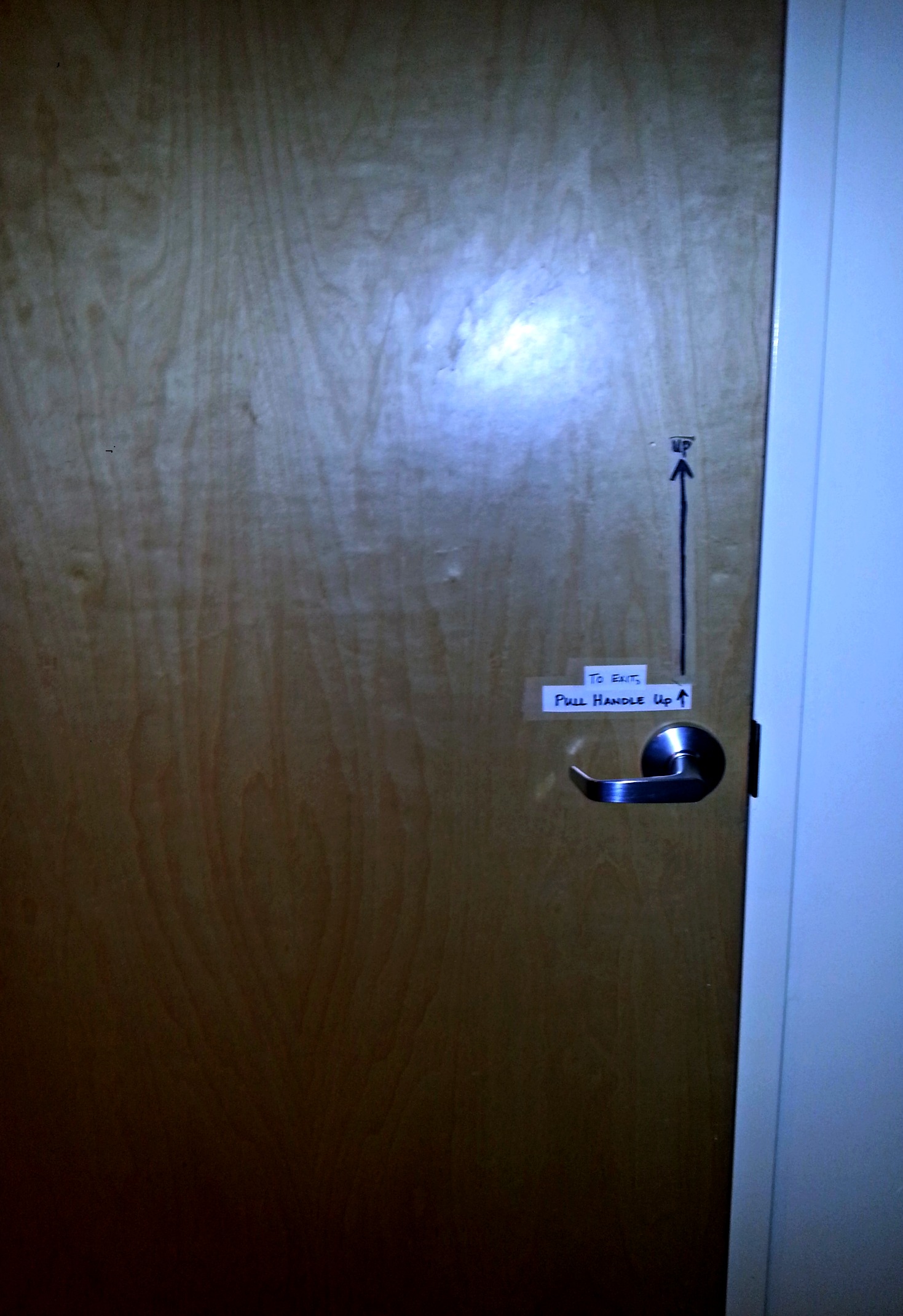
interior doorThe door would be normal except that the door handle is pulled up and the door is pulled to exit.

That’s two strikes for most people They can handle the door being pulled in, but complicating things by pulling the door handle up is a bit much. The image is poor because I was inside an imaging center with someone and had to hurriedly grab a cell phone photo while the radiology tech intoned, “Pull Up” in a tone usually heard when parents tell a pre-teen, well, anything for the fifth time that day.

The room behind us had machines that cost more than my car, maybe more than my first home.  There were other rooms with MRI machines and other acronyms that most people hear during bad times or on television.

The place was a tribute to modern medicine, scientific advancement and the best that money can buy.

Except for the door.

And let you think I’m going to rail about the door handle being installed in a way that isn’t typical, I am here to reassure you that I understand these things happen.  They’re dumb things to have happen when everything else is great, but we all understand they happen.


My issue is with the two pieces of tape that read:

To Exit,

Pull Handle Up ^

Worsening matters is the up arrow drawn in black marker and unnecessarily labeled “Up” on a door that some purchasing agent negotiated hard to buy for a good price.  All of this activity–the drawing, the two arrows and the word “up” takes place at the waist-high height where most people reach a door handle.  This is in a room filled with people who don’t regularly visit so the simple act of opening the door to leave frustrates the staff.  Their annoyed tones are the last thing people here, and the thing they remember.

The answer for this organization is to simply buy the proper door handle and a simple “Pull” sign available at any office supply or hardware store. If the staff really had to take matters into their hands, something posted at eye-level would help.

But even that only solves the problem of the door in the imaging room.  The bigger, possibly organization-wide issue is that no one is experiencing the organization as a customer does. This minor issue could be a symptom of something bigger.  At best, the cheapo solution doesn’t work. At worst, people may leave with a sense that of something amiss, all because of frustration around a door handle and the way the organization dealt with it.

Your takewaway as an organization’s leader is to walk through your organization this week like a client or prospect does.  What takes special knowledge to understand, and what is idiosyncratic to your firm?  Could you benefit from a mystery shopper program?

What kind of messages is your firm sending for lack of a minor change?

You don’t have to pay a lot for a program if your firm is still small. Offer to switch places with a trusted partner and compare notes.  You’ll bond with your partner, and you’ll both save money.

Sharing on a Pinterest board is a hobby millions of people enjoy. Many marketers, especially national brand marketers, quickly followed the passionate pinners online and began doing what marketers do best.  They did everything possible to encourage people to pin information about their brands.  So far, so good except now the Federal Trade Commission (FTC) says some of the activity can seem a little too much like an undisclosed endorsement.  That is a huge blow for organizations running social media contests.

In a March 20 letter to the attorneys for shoe manufacturer Cole Haan, the FTC’s Mary Engle wrote that a contest Cole Haan had sponsored created a situation where “…participants’ pins featuring Cole Haan products were endorsements of the Cole Haan products, and the fact that the pins were incentivized by the opportunity to win a $1000 shopping spree would not reasonably be expected by consumers who saw the pins.”

Engle, the FTCs Associate Director for Advertising, said the agency would not recommend enforcement action because they had not previously addressed whether a contest entry is a form of material connection.  They also had not yet commented on “whether a pin on Pinterest may constitute an endorsement”.  Cole Haan apparently worked with the FTC and adopted a social media policy that would similarly address any similar promotions in the future.

This is important. Read the words again.

The FTC has publicly said that “entry into a contest to receive a significant prize in exchange for endorsing a product through social media constitutes a material connection”.

You already know that people endorsing your brand for an incentive must disclose the relationship. Now the FTC is saying that requiring one of your products to be pinned on a Pinterest board for a contest entry requires that same disclosure. Guidance for other social media contests may be issued, and that is something you should watch for.

Your takeaway as a small business leader is to understand how even innocuous-seeming contest entries in social media channels can create the “material consideration” relationship the FTC warns everyone about.  You should talk with your attorney once and have that person help you create boilerplate you can repurpose later. Not doing so is to create a lot of risk for not much reward.

The link to the FTC’s letter to Cole Haan is in PDF at their site.

Google and The Cleveland Clinic each lost an opportunity to control a new domain name type that could have influenced the already low reputation of medical information published online.

Both organizations have had their applications overruled to run a new TLD (top-level domain) for .med according to industry site Domain Name Wire.

The Top Level Domain Name Rush

dot org typeA top-level domain, called a TLD by insiders, is the short term that appears after a dot in an Internet address. Everyday examples of approved TLDs are .com, .org, .edu and so on.  The international organization that monitors and allows these names is called ICANN, which is just a very long acronym.  ICANN last allowed new TLDs in 2004.  Those included .asia, .mobi and others.  Four years earlier, less commonly used TLDs like .info and .biz joined the ranks of available suffixes.

ICANN proposed that the traditional 3 and 4 letter suffixes could become almost anything at a contentious 2008 meeting.  Each application required at $185,000 evaluation fee.

And the land rush started.

A startup named Donuts spent $57 million on 307 TLDs.  Google, using a subsidiary called Charleston Road Registry, applied for its trademarked terms as well as generic terms like .ADS, .LOVE and .APP.

ICANN keeps the evaluation fee regardless of the award.  That means a company like Donuts sent along more than $50 million for its applications.

The Big Deal – Why Generic TLDs are Dangerous

An ICANN panel ruled that neither The Cleveland Clinic nor Google were allowed to obtain the TLD called .med.   While either company could have registered all diseases, conditions and devices and then sold those names at “market value”, there existed, as in every generic word instance, an opportunity to steer traffic to one organization or charge exorbitant sums for a domain registration.  As a business leader you need to be learning more about domain names that could be registered in your industry and implement a brand protection plan.   You will always be able to protect your trademarked terms, but your competitors may already be planning to get the inside track on location-based or similarly generic names in your industry.


Source: “Google’s and Cleveland Clinic’s .Med top level domains rejected“, Domain Name Wire, 1/2/14
Source:  “New Generic Top-Level Domains“, ICANN, retrieved 1/2/14
Source: “New GTLD Current Application Status“, ICANN retrieved 1/2/14
Image via Wikimedia Commons